The war in the Middle East, following the joint military strike by the United States and Israel against Iran, is no longer confined to the Persian Gulf and the Eastern Mediterranean. Its consequences are being felt far beyond the immediate conflict zone—reaching even Sicily.
The island hosts some of the most important military infrastructures for NATO and U.S. operations in the Mediterranean: the Naval Air Station Sigonella, the MUOS satellite communication system in the Sughereta of Niscemi, and the Trapani–Birgi military airport.
Three very different facilities, yet linked by a common factor: their strategic role in the international geopolitical landscape.
Heightened Alert at U.S. Bases
According to the first reports emerging after the escalation with Iran, the Sigonella base has entered a state of heightened vigilance. The security level has reportedly been raised to “Bravo+”, a condition above normal readiness that includes stricter controls and increased rapid-deployment capabilities.
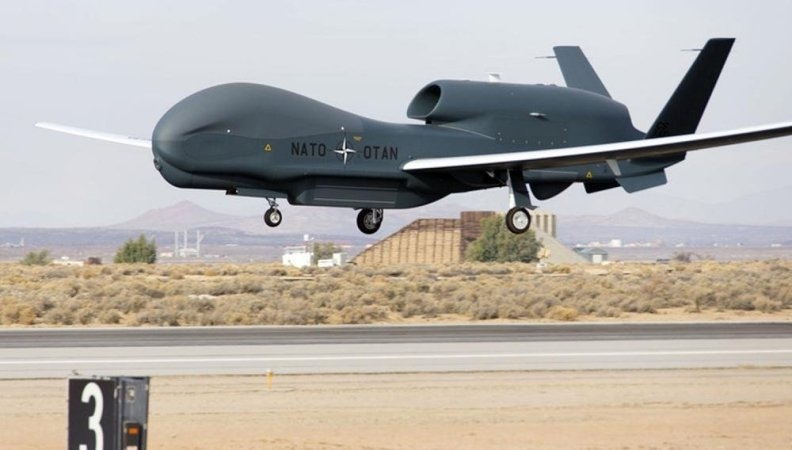
Sigonella is one of the most important operational hubs for the United States outside American territory. Surveillance drones and intelligence aircraft operate from the base, supporting reconnaissance and patrol missions linked to the U.S. Sixth Fleet in the Mediterranean.
In the days surrounding the strike on Iran, unmanned aircraft reportedly departed from Sigonella on reconnaissance missions toward the Middle East, gathering intelligence on potential military targets.
The Strategic Role of the MUOS in Niscemi
Alongside the air base stands another critical infrastructure: the MUOS system in Niscemi.
This facility is one of the four ground stations of the U.S. Navy’s global satellite communication network, designed to ensure real-time connections between naval, air, and ground units anywhere in the world.
During periods of conflict or military escalation, systems like MUOS become essential for coordinating operations and maintaining communications between different war theaters.
For this reason, whenever international tensions rise, the political debate surrounding the Niscemi base inevitably resurfaces.
Birgi and the Strategic Role of Western Sicily
The Trapani–Birgi airbase also plays a role in the broader Mediterranean security framework.
The airport hosts the 37th Fighter Wing of the Italian Air Force and represents one of the key surveillance and defense points for NATO’s southern airspace.
In recent months, the base has also been mentioned as a potential training hub for F-35 pilots, a project that has fueled political debate over the airport’s future strategic role.
Although Birgi is not currently a direct operational platform for attacks in the Middle Eastern conflict, it remains a sensitive military infrastructure, especially in a context of growing international tension.
Political Questions and Calls for Clarification
The issue of the use of Sicilian military bases has quickly reached the political arena.
Questions have been raised both in the Italian Parliament and in the Sicilian Regional Assembly, seeking clarification on whether Italian military infrastructures are being used in operations against Iran and to what extent Italy may be involved.
Among the concerns raised is also the security of the Sicilian territory and the possible consequences of further military escalation in the Mediterranean.
Sicily in the Geopolitical Chessboard
Sicily’s strategic role is not new.
Its geographical position at the center of the Mediterranean makes the island a natural platform for monitoring maritime routes and supporting military operations between Europe, Africa, and the Middle East.
This condition has defined Sicily’s geopolitical importance for decades and becomes particularly visible whenever an international crisis emerges.
Today, with the war between Iran and Israel and the involvement of the United States, that strategic centrality once again becomes evident.
And while the world’s attention remains focused on the Middle East, Sicily finds itself once again in the background of major global geopolitical tensions.
Tourism Fears the Economic Impact of War
If military bases represent the strategic dimension of the Middle East crisis, another sector is watching the escalation with growing concern: tourism.
The effects are not immediate, industry operators say, but they are already beginning to appear, particularly in the American market, one of the most important for Sicily.
According to hoteliers, the war between Israel and Iran risks creating a climate of uncertainty that directly affects bookings for the upcoming summer season.
Cancellations and Slower Bookings
The first signals are coming from some of the island’s most popular destinations, from Taormina to the Trapani coastline.
Several hotels are reporting booking cancellations and a slowdown in new reservations, as tourists ask for updates on the international situation before confirming travel plans.
Industry operators explain that the phenomenon mainly involves U.S. visitors, who tend to be particularly sensitive to geopolitical tensions in the Mediterranean.
According to Federalberghi, the conflict risks affecting a market that had only recently recovered strongly after the pandemic collapse.
The Shadow of Uncertainty
Many tourism professionals are drawing a comparison that clearly reflects the current atmosphere: the Covid period.
Not because of travel restrictions, but because a key element that strongly affects tourism is returning: uncertainty.
When perceptions of international risk increase, travelers tend to delay decisions or choose destinations perceived as farther from crisis areas.
Destinations Most at Risk
The destinations most exposed are those heavily dependent on international tourism: Taormina, the Aeolian Islands, the Egadi Islands, and parts of the western Sicilian coast.
In these areas, the American market represents a significant share of tourist arrivals.
Operators fear that if the crisis continues for weeks or months, cancellations could increase and affect summer bookings.
A Domino Effect on the Local Economy
Tourism is one of Sicily’s main economic engines, and any slowdown would have ripple effects on restaurants, services, transport, and local businesses.
The paradox is that Sicily is not directly involved in the conflict, yet it still suffers the consequences.
It is one of the typical effects of international crises: even thousands of kilometers from the battlefield, economies can be affected by perceptions of instability.
And while the island’s military bases return to the center of the geopolitical chessboard, hoteliers and tourism operators are watching developments closely.
Because war, even when it is far away, can still arrive—at least in the booking charts.
Political Controversy: M5S Walks Out of the Sicilian Assembly
The international crisis and the possible involvement of Sicilian military bases have also sparked political confrontation in the Sicilian Regional Assembly (ARS).
Members of the Five Star Movement (M5S) left the chamber in protest against what they described as an agenda disconnected from citizens’ real concerns.
“Winds of war are blowing even over Sicily, and we still do not know what role the island’s military bases will play in the international scenario,” M5S regional lawmakers said.
“President Schifani has a duty to come to the Assembly and explain this to the Sicilian people.”
Call for Schifani to Address the Assembly
During the parliamentary session, deputy Carlo Gilistro requested the suspension of proceedings to discuss the international situation and its possible implications for Sicily.
According to the Five Star Movement, the regional parliament is discussing secondary issues while concern grows over the war and the role of the island’s military infrastructures.
“We should be debating truly important matters,” the M5S deputies said. “Instead, we are discussing parliamentary questions from almost three years ago or the third mandate for mayors. This parliament continues to be completely disconnected from reality.”
“Sicilians Want to Know”
Speaking in the chamber, Gilistro emphasized the growing concern among citizens over the military escalation in the Middle East.
“Sicilians are rightly worried about this war scenario, which could escalate even further at any moment,” he said.
He called on President Renato Schifani to report officially to the Regional Assembly on the role of the island’s military bases and the extent of Sicily’s involvement in the international scenario.
“To what extent will Sicilian bases be placed at the service of Trump’s interests?” the M5S deputy asked, demanding greater transparency regarding ongoing military activities.
The issue has therefore entered the heart of the regional political debate, as international tensions continue to cast their shadow even over Sicily.
 Sezioni