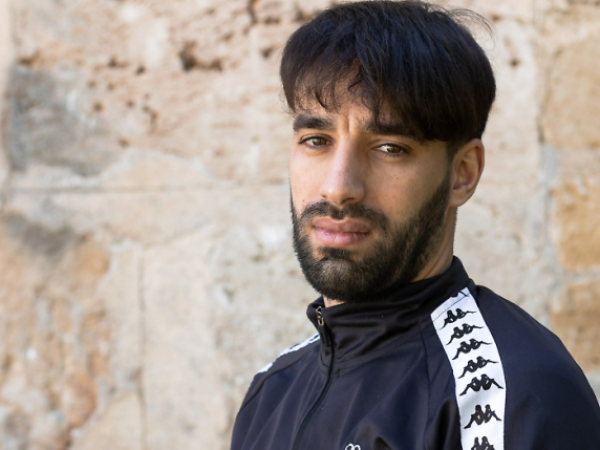
He wanted to come to Europe to play football. He was twenty years old, with a ball in his mind and his eyes, and war behind him. But instead, Alaa Faraj Abdelkarim Hamad became, in the eyes of Italian justice, a "smuggler." And he spent ten years in prison as an innocent man, as those who know him and followed his legal case continue to claim.
It was August 14, 2015, when Alaa, along with two friends—also footballers—set sail from Libya on a rickety boat bound for Italy. He had paid a thousand euros to smugglers in Zuwara, without telling his family. Just hours into the journey, on that overcrowded vessel, unfolded what would go down in history as the “Ferragosto massacre”: 49 migrants died of asphyxiation in the hold, sealed and packed beyond capacity.
The next day, August 15, the Norwegian ship Siem Pilot rescued the boat 135 miles south of Lampedusa. 313 survivors and 49 bodies arrived in Sicily. Initially heard as a witness, Alaa found himself under investigation within hours—together with his two friends. Then came the arrest. Then the trial.
In 2017, the Court of Assizes in Catania sentenced him to 30 years in prison for complicity in multiple homicides and aiding illegal immigration. The conviction was upheld on appeal in 2020 and again by the Supreme Court. A harsh sentence, based—according to the NGO Sea-Watch—on fragile testimonies gathered immediately after disembarkation from people in shock, and on racial profiling that instantly identified the Libyans as guilty.
“Alaa and his companions were treated as scapegoats, not as the true perpetrators,” Sea-Watch repeatedly stated.
Meanwhile, the young Libyan learned Italian behind bars, wrote letters, and studied. Twenty-seven letters addressed to Professor Alessandra Sciurba, a lecturer at the University of Palermo, became a book: "Because I Was a Boy" (Sellerio). The texts were intentionally left in imperfect Italian, the one he learned in prison.
“I met a young man who never stopped believing in Italian justice,” Sciurba said.
“This story shows how immigration laws target the weakest, not the real traffickers.”
Father Luigi Ciotti also spoke out, calling for “a further pursuit of truth and justice for those paying a disproportionate price.” Five years ago, even the authorities in Benghazi attempted a prisoner exchange: the release of Alaa and the other two men in return for the 18 fishermen from Mazara del Vallo detained in Libya. The attempt failed.
Now, after ten years of imprisonment, a signal has come from the Quirinale. The President of the Republic has granted Alaa a partial pardon, cancelling 11 years and 4 months of his sentence. Nine years remain, allowing him to qualify for alternative measures, such as day-release.
In the reasoning, the President's office took into account:
- Alaa's young age at the time of the events;
- the length of time already served;
- the rehabilitation efforts, recognized by the supervising judge;
- the tragic context in which the incident occurred.
Even the Court of Appeal in Messina, in rejecting a request for retrial, had noted that only a pardon could balance the gap between the sentence and the degree of actual guilt.
Some—especially in far-right circles—have expressed “concerns” over the decision. But for many others, it represents a first, partial step toward justice.
The dream of football is still stuck ten years in the past. But freedom, perhaps, is now a little closer.
 Sezioni