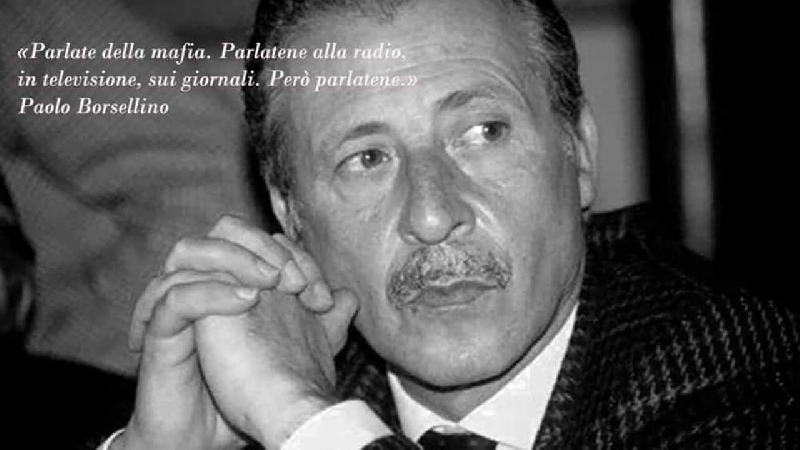
Today, July 19th, marks 33 years since the assassination of Paolo Borsellino, the anti-mafia prosecutor who was killed by a car bomb in Palermo in 1992, just 57 days after the murder of his colleague and friend Giovanni Falcone. Together, they symbolized the State’s most determined fight against Cosa Nostra. Their deaths marked the peak of the mafia’s brutal offensive against Italian institutions.
The Lost Notebook
One of the most enduring mysteries surrounding Borsellino’s murder is the disappearance of his red notebook, known as the “agenda rossa.” This was the diary he carried everywhere, filled with notes on his investigations. The bag that held it was recovered from the car wreck, but the notebook was missing—and has never been found.
Its contents could have revealed potential links between Cosa Nostra, the police, magistrates, politicians, and powerful business networks. A photo of a police officer walking away with a bag that closely resembles Borsellino’s has long fueled speculation and suspicion. That same bag was later found—without the notebook—in the office of a senior police officer, with no official explanation.
A Nation in Crisis
Borsellino was killed during a period of political chaos in Italy. The collapse of the Cold War political order had upended the system. The once-powerful Christian Democrats—who had tolerated and even protected mafia interests—were losing control, unable to uphold old "understandings" with organized crime.
Cosa Nostra responded with violence. Bombings, assassinations, and terror were used as a way to pressure the state. Prosecutors like Falcone and Borsellino, who had launched the landmark Maxi Trial in 1986 (putting hundreds of mafiosi behind bars), became prime targets.
It is widely believed that Borsellino was investigating a potential secret negotiation—la trattativa—between the State and the mafia when he was killed. Soon after his death, Cosa Nostra stopped its campaign of terror. Some say this was the result of a deal: the mafia would end its violence in exchange for lighter laws and reduced pressure.
The Trial and the Doubts
This theory culminated in a controversial trial that began in 2014, with top politicians, police officials, and mafia members accused of facilitating this alleged pact. It was an unprecedented moment: the Italian state putting itself on trial. In 2018, some were convicted. But in 2023, the Supreme Court overturned those verdicts, ruling there had been no such negotiation.
Still, doubt lingers. Historians, magistrates, and citizens remain divided. Former mafiosi have spoken of deals and backchannel talks. Yet in the absence of hard proof, the truth is elusive.
A Legacy Overshadowed
Today, Borsellino is remembered as a national hero. Streets, schools, and buildings bear his name. His courage and integrity continue to inspire Italy’s fight against organized crime.
But the empty space left by the missing agenda rossa casts a long shadow. It is a symbol of what Italy still does not know—and perhaps does not want to know—about that dark chapter in its history.
As his now-exhibited work bag sits in the Italian Senate, onlookers are reminded not only of what was lost in 1992, but also of the unanswered questions that continue to haunt a nation.
 Sezioni