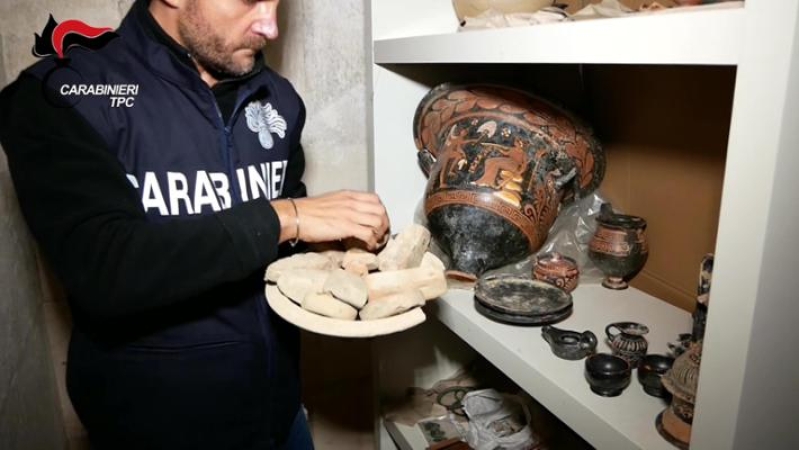
An extensive criminal network involved in clandestine excavations, forgery, and the illegal trafficking of archaeological artifacts—also with international connections—has been dismantled in Operation “Ghenos”, coordinated by the Catania District Anti-Mafia Prosecutor’s Office and carried out by the Carabinieri’s Cultural Heritage Protection Unit of Palermo. Two police officers were also arrested.
As explained by District Prosecutor Francesco Curcio, the investigation began in 2021 and involved 79 suspects, 45 of whom were subjected to precautionary measures. During the investigation, approximately 10,000 archaeological artifacts were seized, many of them of significant historical and cultural value. Investigators uncovered a true clandestine laboratory—described as a “secret mint”—used to forge archaeological finds and counterfeit coins, as well as to produce falsified documents and private writings aimed at placing illicit artifacts onto the legal market. Some items were found inside a garage in Paternò, a discovery that triggered further investigative developments.
Searches led to the seizure of around 60 high‑tech metal detectors, tools systematically used to locate and plunder archaeological sites. “A real army of instruments to scientifically search for places where valuable coins can be found,” Curcio noted. According to estimates by a court-appointed expert, the total value of the seized goods amounts to about €17 million, confirming—investigators stressed—the existence of a structured and highly profitable criminal industry. During the press conference, the Catania prosecutor made clear that this figure represents only part of the business: “We intercepted just a small portion of the turnover; the overall balance exceeds the revenue of any archaeological museum.”
Over the course of the investigation, six arrests were made in flagrante delicto. In one case, a man was stopped at the airport while attempting to board a flight carrying 15 ancient coins tucked into the same coin purse used for loose change. In other instances, Carabinieri caught looters conducting clandestine digs within archaeological sites. The inquiry reconstructed the entire illicit supply chain—from operatives in Sicily, particularly in the Catania and Syracuse areas, to intermediaries and international sales channels. According to findings, coins and artifacts were purchased by international dealers and later auctioned abroad, including in London and Munich.
A central step in the system was the “laundering” of artifacts through the production of false certificates and documentation. “Those who buy at auction appear to do so in good faith,” the prosecutor explained, “but the issue is how looted pieces are able to pass through prestigious auction houses or antiquarian shops.” Two members of the security forces were also placed under precautionary measures during the investigation; the prosecutor clarified that there is no evidence they used their institutional roles to facilitate the illegal activity. Based on the findings, Sicilian mafia involvement has been ruled out in the organization of the looters arrested by the Catania prosecutor’s office.
 Sezioni